
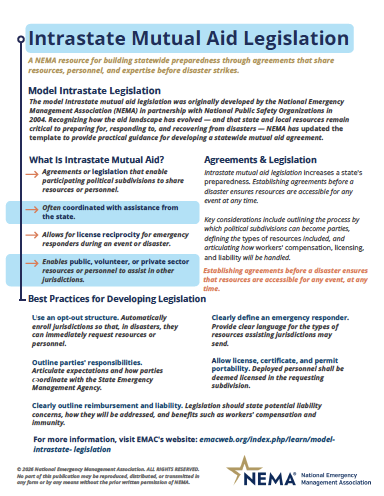
 The Model Intrastate Mutual Aid Legislation has been updated from the original model published in 2004 to better reflect how mutual aid is used today and to more closely align terminology and core concepts with EMAC. The revised template preserves the purpose of the original model: to help states establish a clear, statewide system for sharing resources among political subdivisions before, during, and after emergencies. However, the updated language strengthens the statewide mutual aid structure, modernizes activation language, clarifies reimbursement and workers’ compensation provisions, and reinforces the role of the State Emergency Management Agency in chairing the State Intrastate Mutual Aid Committee.
Key Changes from the 2004 Model
- Shifted to an opt-out structure: All political subdivisions within the state are subject to the agreement unless they withdraw through written notice, with language added to allow a political subdivision to opt back in later.
- Removed the local declaration requirement: The updated template expands use of the agreement beyond a locally declared emergency to any incident, event, or disaster that exceeds local capabilities, as well as authorized drills or exercises.
- Aligned terminology with EMAC: The revised language uses “requesting” and “assisting” parties or political subdivisions to better mirror EMAC terminology.
- Clarified workers’ compensation: The workers’ compensation article was revised to make benefits clearer and more closely aligned with EMAC’s approach.
- Expanded emergency responder language: Article II now includes responders from the public, volunteer, and private sectors.
- Strengthened state leadership: The template now states that the State Mutual Aid Committee shall be chaired by the State Emergency Management Agency.
Model Intrastate Mutual Aid Legislation
Article I: Purpose
The purpose of this legislation/agreement is to create a system of intrastate mutual aid between political subdivisions in the state. Each participant of this system recognizes that emergencies transcend jurisdictional boundaries and often exceed the emergency response and recovery capabilities of any one jurisdiction, and that such incidents may result in needs that a political subdivision may be unable to meet with existing resources, but that another political subdivision may be able to provide. Participants also acknowledge that intergovernmental coordination is essential for the protection of lives and property and for the best use of assets, both public and private. The system shall provide for mutual assistance among political subdivisions in the prevention of, response to, and recovery from any incident, event, or disaster that exceeds the local capabilities of a political subdivision, subject to the discretion of the chief executive officer or their designee in that political subdivision. The system shall provide for mutual cooperation among political subdivisions in conducting disaster-related exercises, testing, or other training activities. This legislation provides no immunity, rights, or privileges for any individual responding to an incident, event, or disaster that is not requested and/or authorized to respond by a political subdivision.
This legislation/agreement also creates the State or Statewide Intrastate Mutual Aid Committee. This committee shall be multidisciplinary and representative of emergency management, response disciplines, and local government. It shall be the committee's responsibility to hold, at a minimum, annual meetings to review the progress and status of statewide mutual aid, assist in developing methods to track and evaluate activation of the system, and to examine issues facing political subdivisions regarding the implementation of this legislation. The committee shall be chaired by the State Emergency Management Agency. The committee may prepare an annual report on the condition and effectiveness of mutual aid in the state and make recommendations for correcting any deficiencies. Members of the committee shall serve a maximum two-year term, with recommendations for appointment coming from each respective association.
All political subdivisions within the state are subject to this agreement. Any political subdivision may withdraw by providing written notice of withdrawal to the Director of the State Emergency Management Agency. Following a thirty-day notice period, the political subdivision will no longer be subject to this legislation/agreement. If a political subdivision withdraws from this legislation/agreement, but later wishes to reenter this legislation/agreement, it may do so by providing written notice of such to the Director of the State Emergency Management Agency. This legislation does not preclude political subdivisions from entering into supplementary agreements with another political subdivision and does not affect any other agreement to which a political subdivision may currently be a party or decide to be a party to. Additionally, this agreement does not prohibit political subdivisions from receiving any applicable and eligible state or federal funding.
Article II: Emergency Responders Defined
An emergency responder is defined as anyone with special skills, qualifications, training, knowledge, or experience in the public, volunteer, or private sectors that would be beneficial to a political subdivision in response to an incident, event, disaster, authorized drill, or exercise; and who is requested and/or authorized to respond. Under this definition, an emergency responder may or may not be required to possess a license, certificate, permit, or other official recognition for their expertise in a particular field or area of knowledge. An emergency responder may include, but is not limited to, the following: law enforcement officers, firefighters, emergency medical services personnel, physicians, nurses, other public health personnel, emergency management personnel, public works personnel, those persons with specialized equipment operations skills or training, or any other skills needed to provide aid in an incident, event, or disaster.
Article III: Political Subdivisions' Responsibilities
It shall be the responsibility of each political subdivision with responsibility for emergency management duties to do the following:
- Identify potential hazards and anticipated resource needs using an identification system common to all participating jurisdictions.
- Conduct joint planning, intelligence sharing, and threat assessment development with contiguous political subdivisions, and conduct joint training at least biennially.
- Identify and inventory the current services, equipment, supplies, personnel, and other mutual aid resources related to planning, prevention, mitigation, response, and recovery activities of the political subdivision.
- Adopt and implement a standardized incident management system approved by the State Emergency Management Agency.
Article IV: Implementation
A political subdivision may request assistance from other political subdivisions in preventing, mitigating, responding to, and recovering from disasters or emergencies, or in concert with authorized drills or exercises as allowed under this legislation/agreement. Requests for assistance shall be made through the chief executive officer of a political subdivision or their designee. Requests may either be verbal or in writing and are not required to go directly to the State Emergency Management Agency, but in all cases will be reported to the agency as soon as is practical. Verbal requests will be followed up with a written request as soon as is practical or within a number of days as the state may dictate. The written request should include information regarding what the incident, event, or disaster is, the amount and type of resources needed, and the requested time period for which resources are needed.
Article V: Limitations
A political subdivision's obligation to provide assistance in the prevention of, response to, and recovery from an incident, event, disaster, or in authorized drills or exercises is subject to the following conditions:
- A political subdivision requesting assistance shall have an incident, event, or disaster that exceeds local capabilities or request resources for authorized drills and exercises.
- A political subdivision may withhold resources to the extent necessary to provide reasonable protection and services for its own jurisdiction.
- Emergency response personnel of an assisting political subdivision shall continue under the command and control of the assisting jurisdiction, to include medical protocols, standard operating procedures, and other protocols, but shall be under the operational control of the appropriate officials within the incident management system of the requesting political subdivision for the duration of rendering aid.
- Assets and equipment of an assisting political subdivision shall continue under the control of the assisting jurisdiction but shall be under the operational control of the appropriate officials within the incident management system of the requesting political subdivision for the duration of rendering aid.
Article VI: License, Certificate, and Permit Portability
Whenever a person or entity holds a license, certificate, or other permit issued by a political subdivision or the state evidencing qualification in a professional, mechanical, or other skill and when such assistance is requested by a political subdivision, the person or entity shall be deemed to be licensed, certified, or permitted in the requesting political subdivision to render aid involving such skill for the duration of incident, event, disaster or authorized drill or exercise. Subject to any limitations and conditions the chief executive of the requesting political subdivision may prescribe by executive order or otherwise.
Article VII: Reimbursement, Disputes Regarding Reimbursement
Any requesting political subdivision shall reimburse the assisting political subdivision rendering aid under this system. An assisting political subdivision may donate services or assets of any kind, including personnel costs, to the requesting political subdivision. Such requests for reimbursement shall be in accordance with procedures developed by the State Intrastate Mutual Aid Committee.
Should a dispute arise between the requesting and assisting parties regarding reimbursement, the parties will make every effort to resolve the dispute within 30 days of written notice of the dispute by the party asserting noncompliance. In the event that the dispute is not resolved within 90 days of the notice of the claim, either party may request that the dispute be solved through arbitration. Any arbitration under this provision shall be conducted under the commercial arbitration rules of the American Arbitration Association.
Article VIII: Development of Guidelines and Procedures
The State Intrastate Mutual Aid Committee shall develop comprehensive guidelines and procedures that address, including but not limited to, the following: projected or anticipated costs, checklists for requesting and providing assistance, record keeping for all political subdivisions, reimbursement procedures and documentation, and other necessary implementation elements along with the necessary forms for requests and other records documenting deployment and return of assets.
Article IX: Workers' Compensation
Personnel of an assisting political subdivision responding to or rendering aid who sustain injury or death while rendering aid pursuant to this legislation/agreement are entitled to all benefits in the same manner and on the same terms as if injury or death were sustained within their own jurisdiction. Additionally, workers’ compensation benefits are not eligible for reimbursement.
Article X: Immunity
All activities performed under this legislation/agreement are deemed hereby to be governmental functions. For the purposes of liability, all persons responding under the operational control of the requesting political subdivision are deemed to be employees of the requesting political subdivision. Neither the political subdivisions nor their employees, except in cases of willful misconduct, gross negligence, or bad faith, shall be liable for the death of or injury to persons, or for damage to property when complying or attempting to comply with the statewide mutual aid system.
Article XI: Severability
Should a court of competent jurisdiction rule any portion, section, or subsection of this legislation/agreement invalid or nullified, that fact shall not affect or invalidate any other portion, section, or subsection; and all remaining portions, sections, or subsections shall remain in full force and effect.